
4 Best Sewing Machine for Making Drapes on a Budget
The SINGER 4411 Heavy Duty Sewing Machine is the best sewing machine for making drapes for most buyers. Its main advantage is a sturdy design with a strong motor, which helps sew heavier curtain fabrics without complicated controls. The mechanical layout also keeps adjustments simple for common straight seams, hems, and basic gathers.
This guide is for home sewists making curtains, valances, room dividers, or other large fabric panels. The key factors are the machine’s working space and its ability to keep stitches even through thick materials. Long panels can crowd a small sewing bed, while layered hems can strain a weaker machine. The four picks below are ranked with clear reasons and honest drawbacks for each, so you can match the machine to your fabric, project size, and sewing experience.
Quick Comparison
| # | Product | Best For | Price | |
|---|---|---|---|---|
| 1 | SINGER 4411 Heavy Duty Sewing Machine | Heavy-Fabric Home Sewing | $179.99 | View → |
| 2 | Brother XM2701 Portable Sewing Machine | Beginner Portable Sewing | $149.00 | View → |
| 3 | Brother CS7000X Sewing and Quilting Machine | Quilting and Decorative Stitching | $279.99 | View → |
| 4 | Handheld Sewing Machine | Quick On-the-Go Repairs | $19.99 | View → |
4 Sewing Machines for Making Drapes
These picks are ranked by fabric control, throat space, and useful features, counting down to the top choice.
4. Handheld Sewing Machine

Best for: Quick clothing repairs and simple crafts
This $19.99 handheld sewing machine targets beginners who need small repairs without a full-size setup. Its compact ABS alloy body is lightweight, easy to store, and designed for one-hand operation. The single-thread system skips bottom-thread installation, while four thread-set points help keep the stitch path steady. The included sewing kit also gives buyers basic supplies for home repairs, travel, or DIY projects.
The machine is rated for fabrics up to 1.8 mm thick, including clothing, silk, wool, curtains, and some leather. That range suits hems, small rips, toy projects, and loose seams, but fabric thickness can vary by material and weave. A small piece of cloth may arrive attached, or the thread may show a few stitches. The seller says this comes from pre-shipping operation checks, not prior customer use. Its higher-power, lower-noise design sounds useful for casual work, but this remains a compact repair tool rather than a replacement for a standard sewing machine.
Pros
- Single-thread operation avoids installing a bobbin or lower thread.
- One-hand design makes quick repairs easier on clothing, curtains, and crafts.
- The included accessory kit supports immediate home or travel use.
Cons
- The 1.8 mm thickness limit restricts work on heavy denim, layered seams, and thick leather.
- Single-thread stitches can be less secure than standard two-thread seams and may need hand-sewn reinforcement.
3. Brother CS7000X Sewing and Quilting Machine
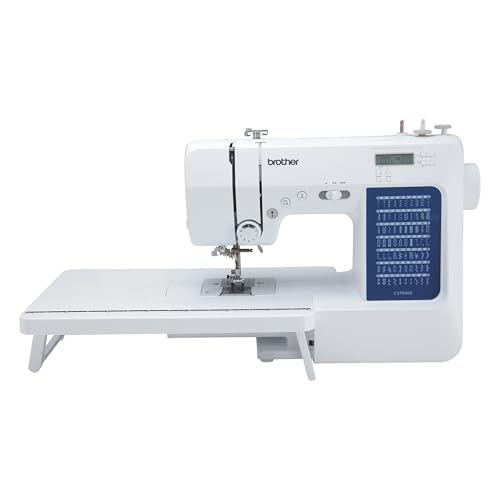
Best for: Home sewists making quilts
The Brother CS7000X is a computerized sewing and quilting machine with an LCD display. It offers 70 built-in stitches for utility sewing, decoration, heirloom work, and quilting. Seven one-step, auto-size buttonholes cover common garment projects. The machine also includes 10 sewing feet, a quilt guide, a wide table, and a protective hard case.
Its metal frame and fixed needle bar support steadier fabric handling and more even stitch lines than a lightweight plastic setup. The improved automatic needle threader pushes thread through the eye, while the drop-in top bobbin loads from above and helps stay in position. A larger needle-to-arm workspace gives bulky quilts more room to move. The LCD screen should make stitch selection and settings easier to follow. Still, the product is designed for US 120-volt use only, so it is not suitable for overseas operation without proper compatibility.
Pros
- 70 built-in stitches cover basic repairs, decorative work, quilting, and heirloom projects.
- Seven one-step buttonholes simplify consistent buttonhole sizing.
- Wide table and larger workspace provide better support for quilts and other large pieces.
Cons
- US 120-volt design limits use outside the United States and may void the warranty elsewhere.
- The machine includes many functions, so new users may need time with the English, Spanish, or French manual.
2. Brother XM2701 Portable Sewing Machine

Best for: Beginners sewing everyday garments
The Brother XM2701 is a portable sewing machine priced at $149. It offers 27 built-in stitches for common repairs, garment projects, and decorative details. The selection includes zigzag, stretch, blind hem, and decorative options, plus an automatic-size buttonhole. Its free arm helps with cuffs, sleeves, and other narrow sections.
Setup includes an automatic needle threader and a drop-in top bobbin designed to resist jams. The box contains six sewing feet, three standard needles, one twin needle, four bobbins, and the instruction manual. Brother also provides technical support by phone, online, or live chat for the life of the machine. This model is made for US use with 120-volt power, so buyers outside the US should not assume warranty coverage.
Pros
- 27 stitches cover repairs, stretch seams, hems, and decoration.
- The free arm makes cuffs and sleeves easier to reach.
- Six feet, four bobbins, and extra needles reduce setup costs.
Cons
- It is limited to 120-volt US use, and other sales or uses may void the warranty.
- The 27-stitch selection may feel restrictive for embroidery-style work or advanced decorative sewing.
1. SINGER 4411 Heavy Duty Sewing Machine

Best for: Home sewing with denim
The SINGER 4411 is a mechanical sewing machine for repairs, garments, home decor, and heavier materials. It has a full metal interior frame and a heavy-duty motor advertised with 50% more power than standard models. That combination supports work with denim, canvas, and some leather, while still handling dress-weight fabric.
Its 69 stitch applications cover basic seams and decorative options, giving this machine more range than a straight-stitch model. Speed is another clear strength. The motor can reach 1,100 stitches per minute, which helps finish long seams and repeated repairs faster. A top drop-in bobbin uses a clear cover, so you can check the remaining thread without removing the bobbin. At $179.99, it offers a practical feature set for sewists who want a sturdy machine without moving into a computerized model.
Pros
- Metal interior frame helps keep the machine stable during heavier sewing.
- Up to 1,100 stitches per minute suits long seams and frequent repairs.
- Clear, top-loading bobbin cover makes thread checks quick.
Cons
- High-speed sewing can be difficult to control on small curves or delicate fabric.
- Leather work may still require the correct leather needle, thread, and presser foot, which are not specified here.
Buying Guide
The most important factor is a strong motor with enough throat space. Drapery panels use long, heavy fabric, so a machine that stalls or offers little room can make straight seams frustrating.
- Motor and fabric capacity: Choose a model that handles multiple layers of denim or upholstery-weight fabric. A throat space of 6 inches or more gives bulky panels better support.
- Stitch control: Look for adjustable stitch length up to at least 4 mm and a speed-control slider. These settings help create steady 10- to 12-foot side seams.
- Presser-foot clearance: A high-lift foot should fit several fabric layers, including a folded 4-inch hem and lining. An included walking foot helps prevent slippery lining from shifting.
- Workspace and table: Prefer an extension table at least 15 inches wide. It supports wide curtains better than a small free arm, which mainly suits sleeves and cuffs.
- Needles, feet, and price: Budget $250 to $700 for a dependable computerized or mechanical model. Confirm support for size 14 to 18 needles, plus a zipper foot, blind-hem foot, and walking foot.
If funds or space are limited, prioritize motor strength and throat space over decorative stitches or a large built-in stitch menu.
Frequently Asked Questions
How do I choose a sewing machine for making curtains?
Choose a sewing machine with a strong motor, a large work area, adjustable presser-foot pressure, and a longer free arm for curtain panels. A machine with a 7-millimeter stitch width and a 6-inch throat space gives bulky hems more room, while straight stitch and zigzag functions cover most drapery seams.
What needle should I use for sewing drapes?
Use a size 90/14 or 100/16 universal needle for most medium-to-heavy curtain fabric. Choose 100/16 for lined cotton, canvas, or thick blackout material, and replace the needle after roughly 8 to 12 hours of stitching. A sharp denim needle can help with dense layers, but test thread tension on a fabric scrap first.
Can a domestic sewing machine handle heavy drapery fabric?
Yes, a domestic sewing machine can make drapes if it feeds several fabric layers smoothly and accepts a suitable needle and thread. Most home models handle two to four layers of cotton or polyester, but thick blackout lining may need slower stitching, a walking foot, or a stronger motor.
Are computerized sewing machines good for making drapes?
Computerized machines are useful for drapes, but a reliable mechanical model can work just as well for long straight seams. Look for speed control, needle-stop positioning, and a 7-millimeter maximum stitch width. Decorative programs matter far less than steady fabric feeding and easy control during long hems.
Conclusion
The SINGER 4411 Heavy Duty Sewing Machine is the top pick for home sewists who need a sturdy, straightforward machine for hemming and sewing medium-to-heavy drapery fabrics. If your priority is quieter operation, decorative stitches, or easier handling of extra-wide panels, choose a model with those features instead, even if it gives up some speed or metal construction. Before buying, double-check the machine’s dimensions, compatibility with your fabric and presser feet, the quantity of included accessories, and the current price. Drapes can demand long seams, careful fabric control, and room around the needle area. A reliable work surface and table extension may matter almost as much as the machine itself. That combination makes curtain projects easier to manage.
