
5 Best Color for Welding Curtains for Safer Shops
For most buyers, VEVOR 2-Piece Welding Curtains is the top pick for the best color for welding curtains because its two-panel design gives you flexible coverage around a welding area. That layout works well for home garages, repair shops, and small fabrication spaces that need a simple barrier between hot work and nearby people or equipment.
This guide is for welders, shop owners, and DIY users choosing curtains for a fixed booth or temporary setup. The key checks are panel size, fabric type, flame resistance, and how easily the curtains open, close, or move. Larger panels protect more surrounding space, while suitable fabric helps block sparks and welding arc light. The 5 picks below are ranked with clear reasons and honest drawbacks for each, so you can match a curtain to your workspace and welding routine.
Quick Comparison
| # | Product | Best For | Price | |
|---|---|---|---|---|
| 1 | VEVOR 2-Piece Welding Curtains | Large Multi-Station Welding Areas | $38.20 | View → |
| 2 | Vincreem Welding Curtain Safety Screen | Compact Home Welding Spaces | $87.99 | View → |
| 3 | Jackson Safety Transparent Welding Curtain | Visibility-Focused Workshop Operators | $39.45 | View → |
| 4 | Vincreem Welding Curtain Screen | Portable Welding Job Protection | $85.99 | View → |
| 5 | Jackson Safety Transparent Welding Curtain | Shared Shop Safety Zones | $41.18 | View → |
5 Welding Curtain Colors Worth Considering
This list is ranked from the fifth choice down to the top pick, with color, shade, and use in mind.
5. Jackson Safety Transparent Welding Curtain

Best for: supervised welding areas with bystanders
This $41.18 Jackson Safety curtain creates a visible barrier around welding work. Its transparent gold, 14 mil PVC vinyl lets welders and nearby supervisors maintain two-way visibility instead of working behind an opaque screen. The material resists tears and handles flame, mildew, and water exposure. It also helps block ultraviolet and blue light, contain sparks and spatter, and reduce some welding noise. As part of a properly designed workspace, the curtain can help contain fumes and vapors for extraction.
Installation is straightforward because the panel includes built-in grommets. They sit 8 inches apart along one width side and 16 inches apart along both height sides. Tubing and framing are not included, so buyers must provide a support system. The actual panel can vary by up to 3 inches in width and height. It meets ANSI/FM 4960, California Fire Marshall standards, and NFPA 701 flame-resistance requirements. Those approvals do not make it a substitute for a welding helmet, visor, goggles, or other required eye protection.
Pros
- Transparent gold PVC supports two-way viewing during supervised welding.
- 14 mil vinyl resists tearing, mildew, water, and flame exposure.
- Spaced grommets simplify hanging from a compatible frame or tube.
Cons
- Tubing or framing is not included, adding setup cost and planning.
- Size may vary by up to 3 inches, which can leave coverage gaps in a carefully measured enclosure.
4. Vincreem Welding Curtain Screen
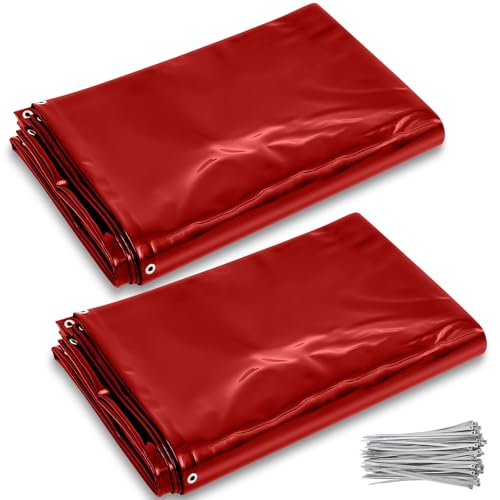
Best for: Small welding bays and workshops
The Vincreem set includes two red welding curtains, each listed at 6 x 8 feet, or 1.72 x 2.44 meters. They hang from a compatible stand using fixed belts, so the package covers the curtain panels rather than a complete enclosure. Tubing and framing are not included. The panels use heavy-duty vinyl, a practical material for repeated shop use around sparks, splashes, and arc exposure. The listed price is $85.99 for the two-pack.
The main advantage is coverage for a defined welding area. Two panels can help separate nearby workers, materials, and equipment while supporting smoke and steam extraction when positioned as a barrier. The product is also marketed to reduce UV and blue-light exposure, noise, and stray arc light. It should not replace approved eye, face, or skin protection. Each panel may vary by up to 2 inches in width and height. The red vinyl can look darker when folded, and its shade may differ from the listing photos.
Pros
- Two 6 x 8-foot panels cover a sizable welding area.
- Heavy-duty vinyl resists tearing during regular shop use.
- Fixed belts support quicker installation on a compatible stand.
Cons
- Tubing or framing is not included, adding to the setup cost.
- Actual panel dimensions can be up to 2 inches smaller or larger, so a precise enclosure may require extra planning.
3. Jackson Safety Transparent Welding Curtain

Best for: Welding bays needing visual separation
The Jackson Safety Transparent Welding Curtain is a 14 mil PVC vinyl panel for separating welding areas from nearby workers. Its transparent orange material allows light into the work zone while creating a visual boundary around sparks, spatter, fumes, and vapors. At $39.45, it provides a practical way to define a welding bay if you already have tubing or a support frame.
Built-in grommets simplify hanging, but the mounting hardware is not included. Grommets sit 8 inches apart along one width side and 16 inches apart along both height sides. The actual dimensions may vary by up to 3 inches in width and height, so measure your opening before ordering. The PVC resists tearing and is resistant to flame, mildew, and water. It meets ANSI/FM 4960, California Fire Marshal standards, and NFPA 701 flame-resistance requirements. The curtain can help contain fumes for extraction and reduce some shop noise. It is not a replacement for a welding helmet, goggles, eyewear, or face visor.
Pros
- Transparent orange PVC lets more light reach the welding area.
- 14 mil material resists tears, water, mildew, and flame.
- Built-in grommets support flexible hanging layouts.
Cons
- Tubing, framing, and other mounting hardware are not included.
- Variable sizing of up to 3 inches can complicate a precise installation.
2. Vincreem Welding Curtain Safety Screen
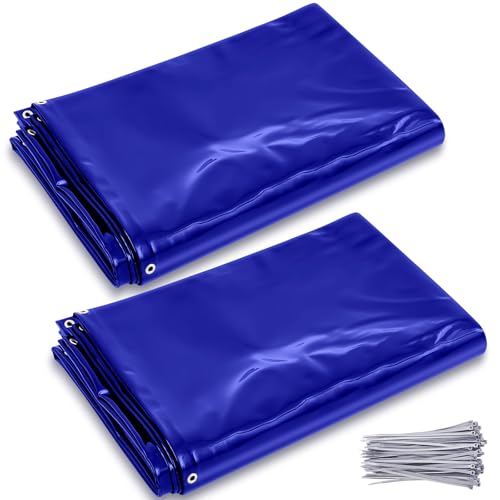
Best for: Home welding bays and small shops
The Vincreem set includes two blue welding curtains, each listed at 6 x 8 feet, or 1.72 x 2.44 meters. They use heavy-duty vinyl with fire-resistant properties and a transparent design that helps separate a welding area while preserving some visibility. A fixed belt supports installation on a compatible 6 x 8-foot stand. Tubing and framing are not included, so buyers must supply the supporting structure.
These screens help block UV and blue light from welding arcs, while also containing sparks, splashes, smoke, and steam within a defined work zone. The barrier can reduce noise and help direct fumes toward an extraction system. The vinyl is tear-resistant, making it better suited to repeated shop use than a thin temporary sheet. At $87.99 for two curtains, the set may fit home garages, repair areas, and factory workstations. Keep in mind that each panel can vary by up to 2 inches in width and height. The dark blue material may also look darker when folded than it appears in product photos.
Pros
- Two 6 x 8-foot panels cover a wide welding area.
- Heavy-duty vinyl resists tears during regular shop use.
- UV and blue-light protection helps shield nearby workers and equipment.
Cons
- Tubing or framing is not included, adding setup cost.
- Actual dimensions may vary by up to 2 inches, and the blue color may differ from the photos.
1. VEVOR 2-Piece Welding Curtains

Best for: Home garages and small workshops
This VEVOR set includes two 6 x 8-foot welding curtains made from flame-resistant vinyl. Together, they cover a wide area around a welding station, helping contain sparks, splatter, and bright arc light. The red panels work well for temporary work zones in garages, workshops, and job sites. At $38.20, the pair offers broad coverage without requiring a permanent enclosure.
Each curtain has six-level UV protection to reduce exposure from welding light. Plastic grommets, reinforced corners, and included zip ties support quick hanging. Machine-pressed edges help resist fraying and tearing along the panel borders. The curtains fold for storage and remain portable between work areas. They do not include a frame, so buyers must provide a suitable support structure, such as a pipe, stand, or wall-mounted rail. The vinyl barrier also should not replace a welding helmet, gloves, protective clothing, or proper ventilation.
Pros
- Two 6 x 8-foot panels provide wide coverage around a welding area.
- Flame-resistant vinyl helps shield nearby surfaces from sparks and hot splatter.
- Grommets, reinforced corners, and zip ties simplify temporary installation.
Cons
- No frame is included, so setup requires a separate hanging structure.
- Curtains reduce UV exposure and glare, but they do not replace certified eye or skin protection.
Buying Guide
The most important factor is protection from ultraviolet and infrared radiation, not the curtain’s color alone. Choose a welding screen with documented UV, IR, and visible-light ratings, since color by itself does not make an area safe to view.
- Light transmission: Select transparent green or amber panels when workers need to see through the barrier, and opaque black panels when blocking the arc completely matters more. Never use a curtain as eye protection.
- Welding process: Match the screen to the arc intensity and process. MIG, TIG, and stick welding can require different protection levels, so follow the manufacturer’s stated rating rather than choosing by color.
- Curtain size: Measure the booth before buying. A 6-by-6-foot panel suits many small work areas, while larger bays may need several panels with at least 12 inches of overlap.
- Material thickness: Look for flame-resistant PVC around 14 to 30 mil thick. Thicker panels usually resist tears, sparks, and frequent movement better.
- Color and visibility: Green is a common general-purpose choice. Amber can improve visibility in dim areas, while dark opaque colors reduce distractions. Confirm the listing identifies welding use and a recognized safety standard.
If you must compromise, prioritize the documented radiation rating over color, appearance, or price.
Frequently Asked Questions
How do I choose a color for welding curtains?
Choose a curtain shade by matching its light-filtering rating to the welding process and the visibility workers need. Dark green panels usually reduce glare around brighter arcs, while orange or yellow panels make people and equipment easier to see. The curtain still does not replace a proper welding helmet or eye protection.
What color welding screen is safest?
The safest option is a welding curtain with a documented shade or transmission rating that fits the job, rather than a color chosen by appearance alone. For example, a booth using high-amperage arc welding may need a darker screen, while a low-light setup may benefit from a lighter panel for visibility.
Can clear or yellow welding curtains block UV light?
Yes, clear or yellow welding screens can block ultraviolet light, but only when the product is specifically rated for welding exposure. Look for published UV and infrared filtration data, not just a color label. An amber panel may improve visibility, yet it should never be treated as eye protection for someone viewing the arc directly.
Are green welding curtains better than orange ones?
Green curtains are not automatically better than orange curtains; the better choice depends on glare control, visibility, and the manufacturer’s filtration rating. Dark green often suits brighter work areas, while orange can make nearby tools and workers easier to see. Compare the listed transmission data before buying either shade.
Conclusion
VEVOR 2-Piece Welding Curtains remain the top pick for home welders, small workshops, and buyers who need two panels at a practical price. If your priority is better visibility around the work area, choose a lighter-colored welding curtain with the correct protection rating, since it can make the surrounding space easier to monitor without exposing others to welding light. Before buying, double-check each panel’s size, the curtain’s compatibility with your frame or track, the number of panels included, and the current price, since listings and bundle contents can change. Also confirm that the stated shade or filtering level matches your welding process and local safety requirements. That final check matters more than color alone.
