
5 Best Couch for Dust Mite Allergy, Easy-Clean Picks
DustmiteX Spray Dust Mite Treatment is the top pick for most buyers because it targets dust mites directly on fabric surfaces. For shoppers searching for the best couch for dust mite allergy, this spray offers a practical way to treat upholstery, cushions, and other soft furnishings without replacing the sofa. Its value comes from addressing the allergen source, not from changing the couch itself.
This guide is for allergy sufferers, parents, and pet owners trying to reduce dust mites around living-room seating. With a treatment like this, the key factors are coverage per bottle and fabric compatibility. Check the label before spraying leather, delicate textiles, or colored upholstery, since materials can react differently. The 5 picks below are ranked with clear reasons and honest drawbacks for each, so you can compare sprays, covers, and furniture-friendly options before choosing one for your home.
Quick Comparison
| # | Product | Best For | Price | |
|---|---|---|---|---|
| 1 | DustmiteX Spray Dust Mite Treatment | Targeted Dust Mite Treatment | $19.95 | View → |
| 2 | Allergy Asthma Clean Allergen Spray | Allergy-Sensitive Bedrooms | $23.99 | View → |
| 3 | Premo Guard Natural Mite Spray | Natural-Minded Households | $24.97 | View → |
| 4 | DustmiteX Dust Mite Spray | Routine Bedding Maintenance | $37.99 | View → |
| 5 | FEPPO Mattress Vacuum Cleaner | Deep Mattress Cleaning | $66.45 | View → |
5 Allergy-Friendly Couch Picks
The list is ranked by allergy-conscious materials, cleanability, and comfort, counting down to the top couch for dust-sensitive homes.
5. FEPPO Mattress Vacuum Cleaner

Best for: Mattress and sofa dust removal
The FEPPO is a corded handheld cleaner for mattresses, sofas, and other fabric surfaces. Its 500-watt motor produces up to 16 kPa of suction, while the roller taps at 30,000 RPM to loosen fine dust and skin flakes. A 7-inch, 18 cm inlet covers a broad strip with each pass. The 16.4-foot cord reduces outlet swapping, but you will need a nearby plug.
Its 253.7nm UV-C lamp turns on when gravity-sensing wheels detect contact, then shuts off when lifted or tilted. FEPPO claims the UV-C and 40,000Hz ultrasonic system removes 99.9% of unseen substances, though that figure is a manufacturer claim, not an independent result. A dual-cup filtration system includes a HEPA filter rated to capture 99.97% of particles down to 0.3 microns. The machine also sends 140°F dry air into fabric. At 3.8 pounds, it is manageable but not especially small.
Pros
- Strong 16 kPa suction and 30,000 RPM tapping target embedded dust and flakes.
- Automatic UV-C shutoff reduces exposure when the cleaner lifts or tilts.
- The 18 cm inlet and long cord cover more fabric with fewer outlet changes.
Cons
- The manufacturer says it is not suitable for picking up pet hair.
- Continuous use can trigger motor overheating protection, causing a temporary shutdown.
4. DustmiteX Dust Mite Spray

Best for: Treating mattresses and pet bedding
DustmiteX is a spray designed to kill dust mites on household surfaces. Its EPA registration number is 67419-1, and the product is intended for use when label directions are followed. One bottle treats up to 100 square feet, which may cover a mattress, pillows, furniture, or several smaller items. The company says one application can remain effective for up to six months.
The formula is colorless and odorless, so it should not leave a visible coating or strong scent behind. Use it on mattresses, pillows, upholstery, fabrics, hard surfaces, and pet beds. Always test a hidden area for colorfastness first. This spray targets live dust mites, not only the waste particles that can trigger symptoms. That distinction may matter for households managing allergy or asthma concerns. Still, it is one part of a broader cleaning routine. The product costs $37.99, and the coverage limit makes the value less attractive for large homes.
Pros
- Treats up to 100 square feet per bottle.
- May protect treated areas for up to six months.
- Works across bedding, furniture, upholstery, hard surfaces, and pet beds.
Cons
- It must not be used on carpets, which limits whole-room treatment.
- Users need to perform a hidden colorfastness test before spraying fabrics.
3. Premo Guard Natural Mite Spray
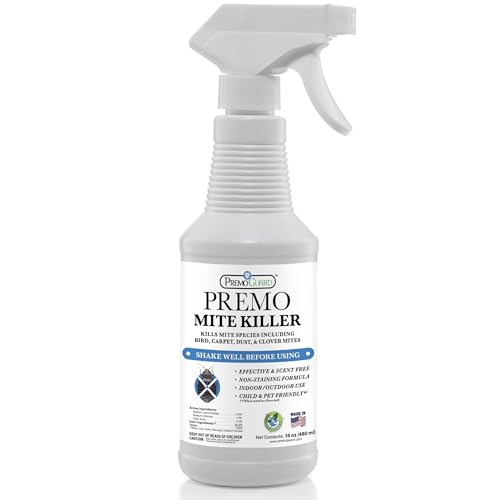
Best for: Homes with mixed mite concerns
Premo Guard Natural Mite Spray is a plant-based treatment priced at $24.97. It is designed for dust, bird, carpet, clover, spider, and rat mites, along with poultry mites in animal areas. The spray can be used on mattresses, couches, pillows, cages, pens, and other surfaces when the label directions are followed. Its unscented, non-staining formula may suit homes where strong chemical odors are a concern.
The product listing says it kills mites on contact across several life stages, including eggs and nymphs. That claim makes it more useful for ongoing control than a spray aimed only at visible adult mites. It is made in the USA and marketed for homes, farms, chicken coops, and livestock spaces. The formula is described as suitable around children, pets, and animals when applied as directed, but users still need to follow safety instructions. No bottle volume is provided in the listed details, so comparing its $24.97 price with larger or smaller alternatives is difficult.
Pros
- Plant-based formula avoids the strong odor associated with many chemical treatments.
- Works across several mite types and household or animal-area surfaces.
- Non-staining use on fabrics such as mattresses, pillows, and couches.
Cons
- Regular applications may be needed for continued mite control, especially in coops, cages, or shared animal spaces.
- The listing does not state the bottle size, making the $24.97 value hard to judge.
2. Allergy Asthma Clean Allergen Spray

Best for: Fragrance-sensitive homes with pets
Allergy Asthma Clean is a mineral-based spray for environmental allergens from dust, dander, and other inanimate sources. It works in the air and on household surfaces such as bedding, pet beds, couches, curtains, floors, and walls. The 33.8-ounce bottle contains concentrate. Add water, shake, and spray. One bottle covers up to 1,200 square feet, and the product can be used daily or as needed.
Its fragrance-free formula contains 100% food-grade mineral ingredients classified as FDA GRAS. It contains no added dyes, VOCs, enzymes, or harsh chemicals. Independent laboratory testing reported reductions of up to 99% of measured allergen proteins on surfaces and up to 95% in the air when used as directed. Those figures describe measured proteins, not guaranteed symptom relief. The spray also has clear material limits. Avoid water-sensitive items, silk, leather, and unfinished wood.
Pros
- Fragrance-free formula suits homes where added scents cause problems.
- One 33.8-ounce bottle covers up to 1,200 square feet after dilution.
- Works on air and many common surfaces, including bedding and pet furniture.
Cons
- You must add water and shake the bottle before use.
- It cannot be used on silk, leather, unfinished wood, or water-sensitive materials, and it does not replace regular cleaning.
1. DustmiteX Spray Dust Mite Treatment

Best for: Dust-mite control in bedrooms
DustmiteX is a pesticide spray designed to kill dust mites, not just reduce the waste and allergens they leave behind. The product listing identifies it as EPA-registered under number 67419-1, with use instructions that buyers must follow carefully. At $19.95, it offers a targeted option for mattresses, pillows, upholstered furniture, fabrics, hard surfaces, and pet bedding. It does not replace regular washing, vacuuming, or other allergy-control steps.
One spray bottle treats up to 100 square feet, and the maker says one application can work for up to six months. The formula is described as colorless, odorless, and non-residue-forming when used correctly. Buyers should test fabric colorfastness first, especially on dark or delicate upholstery. The main distinction is its focus on killing the mite itself. However, the product is not intended for carpets, and the listing does not provide independent performance data beyond its stated EPA registration and application claims.
Pros
- Treats several household surfaces, including mattresses, pillows, furniture, and pet beds.
- Covers up to 100 square feet per bottle.
- The manufacturer claims protection for up to six months per application.
Cons
- It must not be used on carpets, which limits its usefulness in carpeted rooms.
- Fabric surfaces require a colorfastness test before full application, and buyers must follow pesticide directions closely.
Buying Guide
The most important factor is removable, washable upholstery. Covers that can be washed at 130°F can reduce dust mites and allergen buildup more effectively than fixed fabric.
- Washable covers: Choose zippered covers that fit every seat and back cushion. Confirm the care label allows machine washing at least every 2–4 weeks.
- Upholstery material: Smooth leather, faux leather, or tightly woven microfiber traps less debris than loose chenille, velvet, or boucle. Avoid deep, shaggy textures.
- Cushion construction: Pick cushions with removable covers and simple seams. Fewer tufted buttons and fabric folds leave fewer places for dust and skin flakes to collect.
- Cleaning access: Leave at least 3 inches beneath the frame for vacuuming. A couch with removable cushions also lets you clean the deck and crevices with a HEPA vacuum weekly.
- Room moisture: Keep indoor humidity between 30% and 50%. A hygrometer costs about $10–$25, while a small dehumidifier may cost $50–$150. Lower moisture makes the room less favorable to mites.
If you cannot have every feature, prioritize fully removable, washable covers in a smooth, tightly woven material.
Frequently Asked Questions
How do I choose a couch for dust mite allergies?
Choose a couch with tightly woven, washable upholstery, minimal deep cushioning, and removable covers for dust mite allergies. Look for covers that can be washed at 130°F or higher, which helps kill dust mites. Avoid thick fabric skirts, loose-weave chenille, and cushions that cannot be removed for cleaning.
What couch materials are easiest to clean for dust mite allergies?
Leather and tightly woven synthetic upholstery are usually the easiest couch materials to clean for dust mite allergies. A smooth leather sofa has fewer fibers for dust and allergens to collect in than velvet or textured fabric. Wipe hard surfaces weekly, then vacuum seams and under cushions with a HEPA-filter vacuum.
Can washable sofa covers reduce dust mite exposure?
Yes, washable sofa covers can reduce dust mite exposure when you wash them regularly and clean the cushions underneath. Choose machine-washable covers that tolerate water temperatures around 130°F, then dry them completely. Covers help control allergens, but they do not make a fabric sofa completely mite-free.
Are leather couches better for people with dust mite allergies?
Leather couches are often better for people with dust mite allergies because their smooth surfaces trap less dust than many fabric sofas. They still need regular cleaning, especially along seams and beneath cushions. A vacuum with a crevice tool can remove buildup from those areas every one to two weeks.
Conclusion
DustmiteX Spray Dust Mite Treatment is the top pick for shoppers who want a targeted way to treat upholstered seating and reduce dust mite concerns without replacing a couch. If your priority is long-term prevention rather than treating existing fabric, choose a washable, tightly woven sofa cover or a couch with removable, machine-washable upholstery, since regular laundering can help limit dust and allergen buildup. Before buying, double-check your couch size, fabric compatibility, bottle quantity, and current price, then confirm how much treatment the package provides for repeat applications. Keep expectations realistic, too: no spray replaces regular vacuuming, washing, humidity control, and professional advice for serious allergy symptoms.
