
5 Best Japanese Futon Mattress for Small Rooms
For most buyers, the 6th Generation Japanese Floor Futon Mattress is the best japanese futon mattress because it offers a practical balance of floor comfort, easy storage, and everyday versatility. Its floor-ready design suits shoppers who want a simpler sleep setup without committing to a bed frame.
This guide is for apartment residents, guest-room hosts, and anyone comparing traditional-style floor bedding for regular use. Pay close attention to mattress size, folding thickness, and fill materials, since those details affect sleeping space, support, storage needs, and long-term comfort. The 5 picks below are ranked with clear reasons for their placement, plus honest drawbacks for each. That makes it easier to match a futon mattress to your room, sleeping position, and budget.
Quick Comparison
| # | Product | Best For | Price | |
|---|---|---|---|---|
| 1 | 6th Generation Japanese Floor Futon Mattress | Minimalist Bedroom Sleepers | $92.99 | View → |
| 2 | 6th Generation Japanese Floor Futon Mattress | Compact Guest Room Hosts | $59.97 | View → |
| 3 | 6th Generation Japanese Floor Futon Mattress | Portable Camping Mattress Users | $83.99 | View → |
| 4 | MAXYOYO Japanese Floor Mattress | Budget-Conscious Floor Sleepers | $89.99 | View → |
| 5 | Zelladorra Japanese Floor Futon Mattress | Firm Support Seekers | $69.99 | View → |
5 Japanese Futon Mattresses Worth Considering
These five shikibuton-style mattresses are ranked by comfort, materials, support, and value, counting down to the top pick.
5. Zelladorra Japanese Floor Futon Mattress

Best for: Portable guest sleeping space
The Zelladorra Japanese floor mattress measures 39 inches wide by 80 inches long, making it a Twin-size option for one sleeper. It weighs 10 pounds and uses a microfiber cover with polyester and memory foam filling. The foam should add cushioning and some sinkage, while the quilted construction helps spread body weight across the surface. Use it on a bedroom floor, in a living room, inside a tent, or as a guest bed. It can also ride in a car for trips.
This package includes a matching dust-proof cover, two securing straps, and a canvas storage bag. The removable cover lets you clean the outer layer without washing the full mattress. When you put it away, fold the pad and store it in a closet or other compact space. The mattress arrives compressed, so creases are possible after opening. The care instructions recommend leaving it in sunlight for two to three days while it regains its fuller shape. That setup period may require patience before use.
Pros
- Twin dimensions give one sleeper 80 inches of length.
- Memory foam and polyester provide cushioning with moderate support.
- Included cover, straps, and storage bag simplify care and storage.
Cons
- It may need two to three days in the sun after unpacking.
- The product details do not list the mattress thickness, so floor cushioning is hard to judge.
4. MAXYOYO Japanese Floor Mattress
Best for: Guests needing a compact floor bed
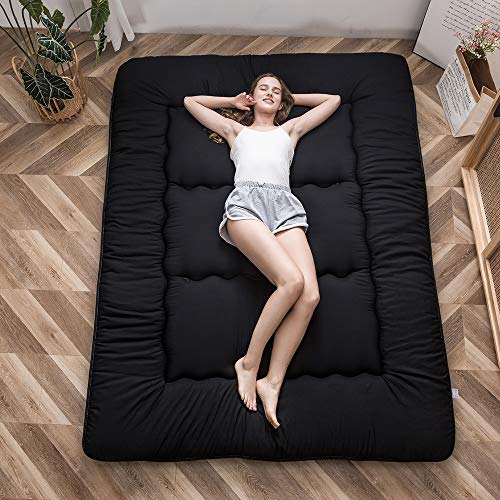
The MAXYOYO Japanese floor mattress is a 4-inch-thick, full-size futon designed for floor sleeping, guest use, camping, and lounging. It measures 54 inches wide by 80 inches long and weighs 13 pounds. The cover uses microfiber, while the filling combines polyester layers with a high-density base support foam center. At $89.99, it offers a lower-cost alternative to a traditional guest mattress.
Its foldable design makes storage and transport easier. Each purchase includes one mattress, a matching dustproof cover, a pair of fastening straps, and a storage bag. The cover helps protect the mattress between uses, while the straps keep it compressed for carrying. Since the mattress arrives tightly compressed, the manufacturer recommends placing it in sunlight and allowing two to three days for it to regain its full thickness. It can also function as a tatami-style mat, tent pad, play surface, or floor couch.
Pros
- Full-size 54-by-80-inch sleeping area fits most adult guests.
- High-density foam in the middle layer provides more support than loose filling alone.
- Dustproof cover, straps, and storage bag simplify protection and storage.
Cons
- It needs two to three days to recover after unpacking, so it is not ready immediately.
- A 4-inch floor mattress may feel too low or firm for buyers accustomed to a raised bed.
3. 6th Generation Japanese Floor Futon Mattress

Best for: Adults needing a portable guest bed
This full-size Japanese-style floor futon measures 54 by 80 inches, giving one adult a broad sleeping surface. Its nine-layer build includes five padding layers made with 100% high-density foam. The design aims to spread body pressure and provide firmer support than a thin sleeping pad. At $83.99, it offers a lower-cost alternative to a traditional bed or bulky guest mattress.
The microfiber cover uses three-dimensional lattice stitching to hold the filling in place. That should help the surface stay more even during regular use, though it does not guarantee the futon will never flatten. You can use it as a bedroom mattress, living room floor bed, dorm pad, tent mat, or children’s play surface. It also folds or rolls for car travel, but the listing does not provide its packed size or weight. Plan for a waiting period after unpacking. Expansion may take three days in warm weather or up to three weeks in colder conditions.
Pros
- Full-size 54-by-80-inch dimensions suit most adult sleepers.
- Nine layers and five padding sections provide more cushioning than a basic floor mat.
- Lattice stitching helps keep the microfiber-covered filling distributed across the surface.
Cons
- The futon needs three days to three weeks to reach its intended thickness.
- No packed dimensions or weight are listed, so storage and carrying may be less convenient than expected.
2. 6th Generation Japanese Floor Futon Mattress

Best for: Guests, dorms, and floor sleeping
This twin-size Japanese-style futon measures 39 by 80 inches and costs $59.97. Its nine-layer build includes five padding layers made with high-density foam. That gives it more structure than a thin roll-up mat, while the microfiber cover adds a softer sleep surface. It can work as a spare bed, floor mattress, tatami-style pad, or children’s play mat.
The quilted cover uses three-dimensional lattice stitching to help hold the filling in place and create a more even surface. The foam is designed to spread pressure across the body, which may feel helpful for sleepers who need more support than a basic blanket pad provides. It folds or rolls for car travel, camping, and temporary sleeping space. Keep expectations realistic after opening. Since the mattress arrives tightly compressed, full expansion can take three days in warm conditions or up to three weeks in cold weather. The barcode label identifies the standard size, so the compressed package will look much smaller than the finished futon.
Pros
- 39-by-80-inch twin dimensions fit guest rooms, dorms, and many floor spaces.
- Nine layers and five padding layers provide more body support than a thin sleeping mat.
- Portable design works for travel, camping, play areas, and overnight guests.
Cons
- Full expansion can take up to three weeks in cold weather.
- A floor futon offers less height and edge support than a raised bed, which may be harder to use for people with limited mobility.
1. 6th Generation Japanese Floor Futon Mattress
Best for: Guest rooms and dorm floors
This 60-by-80-inch queen-size floor futon costs $92.99 and provides a padded sleeping surface without a traditional bed frame. Its nine-layer construction includes five padding layers and 100% polyurethane, high-density foam. That combination aims to support the body while spreading pressure across the mattress. It can work in a guest room, dormitory, bedroom, or on a tatami-style floor.
The microfiber cover uses three-dimensional lattice stitching to help keep the interior filling in place. That design may create a more even surface and reduce shifting during use. Its foldable, portable format also suits floor seating, children’s play areas, tent use, or car travel. Keep expectations realistic after unpacking. The mattress needs about three days to expand in warmer conditions, while colder rooms may require up to three weeks.
Pros
- Nine layers and five padding sections provide more structure than a thin floor pad.
- High-density polyurethane foam offers body support and pressure distribution.
- The 60-by-80-inch size fits one adult and works as a guest sleeping surface.
Cons
- It may arrive compressed and unusable for several days or weeks while expanding.
- A floor futon sits low, so getting up can be harder than with a standard bed.
Buying Guide
The most important factor is thickness, because a Japanese floor futon needs enough padding for your sleeping position and surface. A 2.5-inch pad may suit back sleepers on a tatami mat, while side sleepers often need about 4 inches or more.
- Thickness and firmness: Choose 2.5–4 inches for floor use. Side sleepers should favor thicker padding, while stomach sleepers may prefer a firmer, thinner design.
- Size and dimensions: Compare measured dimensions, not labels alone. Common Japanese sizes include about 39 by 79 inches for single and 55 by 79 inches for double. Confirm the frame or floor space first.
- Fill material: Cotton feels firm and compresses over time. Polyester usually costs less and keeps its loft longer. Wool adds warmth but can cost more and may need careful cleaning.
- Moisture care: If the futon sits on the floor, choose a washable cover and plan to lift it daily. Air the mattress outdoors or near an open window for several hours each week.
- Folding and storage: Look for a three-fold design if storage matters. Check the folded size and weight, since a thick double futon can be difficult to move alone.
If you cannot have everything, prioritize thickness and firmness suited to your sleeping position.
Frequently Asked Questions
How do I choose a Japanese futon mattress?
Choose a Japanese futon mattress by matching its thickness, fill, firmness, and storage needs to your sleeping style. Side sleepers often need a thicker model, while back sleepers may prefer firmer support. Common shikibuton sizes range from twin to king, with many measuring about 3 to 5 inches thick.
What is a Japanese futon mattress?
A Japanese futon mattress is a low-profile sleeping pad, usually called a shikibuton, designed to rest on a tatami mat, platform, or clean floor. Many models use cotton, polyester, foam, or layered combinations. Unlike a thick Western futon, it often folds or rolls for daytime storage.
Can a Japanese futon mattress be used on the floor every night?
Yes, a Japanese futon mattress can be used on the floor every night if the surface stays dry and the pad gets regular airing. Moisture can collect underneath, especially in humid rooms. Fold or hang the futon several times each week, and use a breathable mat underneath for added airflow.
Are Japanese floor mattresses good for back pain?
Japanese floor mattresses can help some people with back pain, but they are not a guaranteed treatment. A medium-firm pad around 3 to 5 inches thick may provide steadier support than a very soft model. Anyone with ongoing pain should ask a healthcare professional before changing sleep surfaces.
Conclusion
The 6th Generation Japanese Floor Futon Mattress is the top pick for shoppers who want a supportive, foldable sleep surface for guest rooms, small apartments, or regular floor sleeping. If your priority is a softer feel, easier storage, or a lower price, choose an alternative with the thickness, fill, and folding design that match your routine. Before buying, double-check the mattress size, compatibility with your tatami mat or platform, the quantity included, and the current price, since listings can change. Also consider where you will store it during the day and how often it needs airing. A good shikibuton should fit your space, sleeping style, and storage habits without creating extra work.
