
5 Best Bookshelf Speakers for Low Volume Listening, TV
For most buyers, the Polk Audio T15 Bookshelf Speakers are the best bookshelf speakers for low volume listening. Their two-way design pairs a 5.25-inch composite woofer with a 0.75-inch silk-dome tweeter, giving quiet rooms a fuller range than tiny desktop speakers. These are passive speakers, so they need an amplifier or stereo receiver, but they fit easily into a budget system. The front port also allows flexible placement near a wall, although room size and amplifier quality still affect the result.
This guide is for apartment listeners, office workers, and anyone who wants music, podcasts, or television audio without filling the room. With bookshelf models, pay closest attention to cabinet size and driver design, since both affect detail and low-end sound at low volume. Amplifier requirements matter too, especially with passive pairs like the T15. The five picks below are ranked by their fit for quiet listening, with clear reasons and honest drawbacks for each.
Quick Comparison
| # | Product | Best For | Price | |
|---|---|---|---|---|
| 1 | Polk Audio T15 Bookshelf Speakers | Apartment stereo beginners | $125.00 | View → |
| 2 | Edifier R1280T Powered Bookshelf Speakers | Vinyl listeners with RCA gear | $129.99 | View → |
| 3 | Saiyin Powered Bluetooth Bookshelf Speakers | Budget Bluetooth streaming | $69.99 | View → |
| 4 | RIOWOIS Powered Bookshelf Speakers | Desktop PC audio upgrades | $49.99 | View → |
| 5 | Sanyun SW208 Active Bluetooth Bookshelf Speakers | Compact gaming setups | $55.99 | View → |
5 Bookshelf Speakers for Quiet Listening
This ranked list counts down from the fifth choice to the top pick, focusing on clear sound at modest listening levels.
5. Sanyun SW208 Active Bluetooth Bookshelf Speakers

Best for: Desktop music and casual listening
The Sanyun SW208 is a compact pair of active bookshelf speakers with 3-inch carbon-fiber drivers and a claimed 30 watts per channel. Its wood-style cabinet gives it a more traditional look than many plastic computer speakers. The direct and reflective speaker design aims to create a wider stereo image, though placement will still affect the result.
Connection options include Bluetooth 5.0 and USB. USB audio uses the built-in 24-bit DAC, which can bypass some of a computer’s basic analog audio hardware. A volume knob, plus separate bass and treble controls, sits on the main speaker. That setup makes quick sound changes easier than software-only controls. Sanyun also includes a noise-filtering system for standby mode, so the speakers are designed to remain quiet when no audio plays. At $55.99, the SW208 offers useful desktop features without taking up much space. Still, its small drivers cannot be expected to produce the same bass weight as larger speakers or a system with a subwoofer.
Pros
- USB input with a built-in 24-bit DAC can provide a direct digital audio connection.
- Bluetooth 5.0 supports wireless playback from phones, tablets, and computers.
- Separate bass and treble knobs allow fast, physical sound adjustments.
Cons
- The 3-inch drivers have limited low-end reach compared with larger bookshelf speakers.
- The feature list names USB and Bluetooth connections, but does not list optical, RCA, or auxiliary inputs.
4. RIOWOIS Powered Bookshelf Speakers

Best for: Small desks and basic home audio
The RIOWOIS DS6701NP is a pair of powered bookshelf speakers priced at $49.99. They connect directly to compatible devices, so you do not need a separate receiver or amplifier. Bluetooth 5.3 handles wireless playback from phones, tablets, laptops, and other smart devices. Wired options include AUX, optical, and TV-ARC inputs. The remote controls power, volume, input selection, Bluetooth disconnection, and three sound effects.
Its strongest feature is flexibility for the price. You can use AUX with a computer or compatible turntable, Bluetooth for casual listening, or TV-ARC to adjust speaker volume with a television remote. The cabinet uses reinforced MDF with a wood-grain finish and rounded, hand-polished corners. That design should fit more easily beside a record player or monitor than a larger stereo system. Still, check your equipment first. A turntable must transmit Bluetooth, not only receive it. Optical sources also need standard PCM, stereo, or non-surround output. Dolby and DTS signals are unsupported.
Pros
- Powered design connects directly to source devices without an amplifier or receiver.
- Bluetooth 5.3, AUX, optical, and TV-ARC support several listening setups.
- Remote control includes input switching, volume, power, Bluetooth disconnect, and three sound modes.
Cons
- Optical and ARC cables are not included, adding setup costs if you need them.
- It cannot connect to an amplifier or receiver, and turntable Bluetooth compatibility is easy to misunderstand.
3. Saiyin Powered Bluetooth Bookshelf Speakers

Best for: Small desks, TVs, and simple stereo setups
The Saiyin Powered Bluetooth Bookshelf Speakers are a compact pair for music, TV audio, and desktop listening. The active speaker powers the passive unit, so you do not need a separate amplifier or receiver. Each speaker measures 5.3 inches wide, 6.3 inches deep, and 8.6 inches tall. A 3.75-inch woofer and 0.5-inch silk-dome horn tweeter handle the main audio range.
Bluetooth 5.3 connects to phones, tablets, Macs, and PCs without an audio cable. For wired sources, you get optical, coaxial, 3.5mm, and RCA-compatible connections. The speakers also support a turntable through LINE OUT, but a model with only PHONO output needs a preamp. A remote controls volume, mute, and input selection, while top-panel buttons provide backup control. One limitation is source compatibility. Connected devices should output PCM, stereo, or non-surround audio to avoid noise or no sound.
Pros
- Bluetooth 5.3 supports wireless playback from phones, tablets, Macs, and PCs.
- Optical, coaxial, 3.5mm, and RCA inputs support several audio sources.
- The powered design avoids buying a separate amplifier or receiver.
Cons
- Turntables with only Bluetooth receiver mode cannot send audio to these speakers.
- The passive speaker connects to the active speaker with speaker wire, so the pair still needs a wired setup and nearby power.
2. Edifier R1280T Powered Bookshelf Speakers
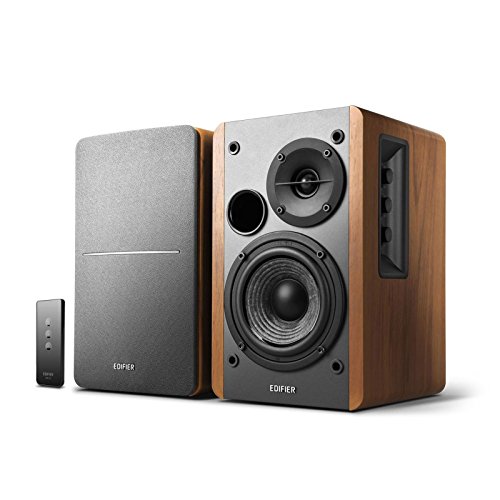
Best for: Desktop listeners wanting simple stereo
The Edifier R1280T is a pair of powered 2.0 bookshelf speakers for desks, small rooms, and wired home audio setups. At $129.99, the set includes an active speaker that powers the second cabinet, so no separate amplifier is required. Its 4-inch full-range drivers handle the main sound, while 13mm silk-dome tweeters cover higher frequencies.
Its most useful feature is connection flexibility. Two AUX inputs let you keep two wired sources connected at once, such as a computer and a phone with a 3.5mm or dual-RCA output. A remote adjusts volume from across the room, while bass and treble knobs sit on the side of the powered cabinet. The cabinets use MDF with a wood-effect vinyl finish, giving them a more traditional look than plain plastic computer speakers. These are near-field monitors, not a full home theater system, but the separate stereo layout fits desks and compact listening spaces.
Pros
- Two AUX inputs support two connected wired sources without swapping cables.
- A 13mm silk-dome tweeter and 4-inch full-range driver provide two-way speaker coverage.
- The included remote changes volume, while side knobs adjust bass and treble.
Cons
- The listed connections are wired, with no Bluetooth option provided.
- Bass and treble controls are on the powered speaker, so changing EQ requires reaching toward the cabinet.
1. Polk Audio T15 Bookshelf Speakers

Best for: First-time home theater buyers
The Polk Audio T15 is a pair of passive bookshelf speakers for music, TV, and surround sound. Each cabinet uses a 5.25-inch Dynamic Balance driver and a 0.75-inch tweeter. The listed 100-watt capacity suits a home theater receiver or amplifier with matching output. Their compact bookshelf design also supports wall mounting, so you can use them as front, left-right, or rear channels.
The main appeal is flexible placement at a reasonable $125 price. The larger driver handles much of the vocal and music range, while the tweeter helps separate higher details. Polk also positions these speakers as a starting point for a larger system. You can add T50 tower speakers, a T30 center channel, and a subwoofer later. Setup stays simple, but these are not powered speakers. You connect speaker wire to an AV receiver before they can produce sound.
Pros
- 5.25-inch drivers provide fuller sound than many compact satellite speakers.
- Wall-mountable cabinets work in front, left-right, or rear positions.
- Pair-based setup allows future expansion with Polk towers, a center speaker, and a subwoofer.
Cons
- They require an AV receiver or amplifier, since the speakers have no built-in power.
- The $125 price covers only two speakers, so a complete surround system costs more.
Buying Guide
Low-volume clarity is the key factor when choosing compact stereo speakers. A model that preserves vocals, guitar, and room detail at 55 to 65 decibels will sound more satisfying than one that only becomes lively at high volume.
- Low-level detail: Look for reviews that mention clear speech and balanced treble below normal conversation volume, around 55 to 65 dB. Avoid speakers that need heavy volume before the sound opens up.
- Amplifier match: Check the rated impedance, usually 4 or 8 ohms, plus sensitivity. Sensitivity near 86 dB or higher can work well with a modest 30 to 50-watt-per-channel amplifier.
- Woofer size: A 4- to 5.25-inch woofer suits desks and small rooms. Choose a 6.5-inch model for fuller bass, but allow at least 8 inches of space from the rear wall when possible.
- Placement flexibility: Front-ported cabinets are easier to position near walls. For rear ports, leave about 6 to 12 inches behind each cabinet and keep tweeters near ear height.
- Inputs and cost: Passive pairs often cost $150 to $500, while powered options may include Bluetooth, optical, and RCA inputs. Choose connections that match your TV, computer, or turntable.
If you cannot have everything, prioritize clear low-level detail over maximum bass or loudness.
Frequently Asked Questions
How do you choose bookshelf speakers for quiet listening?
Choose speakers with clear midrange detail, low hiss, and a smooth sound balance at modest volume. Models with a front port can also be easier to place near a wall, but room size matters. For a desk or small room, a model with a 4-inch to 6-inch woofer usually offers enough detail without needing loud playback.
What features make compact speakers sound good at low volume?
The most useful features are low self-noise, balanced midrange, and a volume control that works precisely at quiet levels. A rear bass port is not essential, and it can sound boomy when placed close to a wall. If possible, leave 6 to 12 inches behind rear-ported cabinets.
Can small bookshelf speakers fill a room at low volume?
Yes, small bookshelf speakers can sound satisfying at low volume, but they may lack deep bass or room-filling output. A model with a 4-inch woofer often suits a desk or bedroom, while a larger room may need a subwoofer or bigger cabinet. Keep each speaker at ear height and about 2 to 6 feet apart.
Are powered bookshelf speakers better for quiet listening?
Powered bookshelf speakers are usually better for simple low-volume setups, while passive speakers offer more flexibility if you already own an amplifier. A two-speaker powered set combines the amplifier and speaker connections in the cabinets, so setup may require only a source and one power connection. Passive systems need an amplifier separately.
Conclusion
Polk Audio T15 Bookshelf Speakers are the top recommendation for apartment listeners, desktop users, and anyone who wants balanced, easygoing sound at low volume without paying for a larger, more demanding stereo system. If your priority is deeper bass, a smaller cabinet, or built-in amplification, pick a compact powered alternative instead, since those features can matter more than maximum loudness in a bedroom, office, or small living room. Before buying, double-check the cabinet dimensions against your shelf, confirm the passive or powered design matches your amplifier and cables, verify whether the price covers one speaker or a pair, and check the current listing price because deals change.
