
6 Best Bookshelf Speakers Under $300 for Small Rooms
Polk Audio T15 Bookshelf Speakers is the top pick for most buyers among the best bookshelf speakers under $300. Its main strength is a practical two-way design, with a 5.25-inch composite woofer and 0.75-inch tweeter, at a budget-friendly price. These passive speakers suit music, movies, gaming, and small living rooms without demanding a large setup.
This guide is for shoppers replacing TV audio, building a compact stereo, or adding speakers to a desk. Pay close attention to cabinet size and amplifier compatibility, since these speakers need external power. Driver materials and rear-panel ports also affect placement and sound, especially near walls or shelves. The six picks below are ranked with clear reasons and honest drawbacks for each, so you can compare sound, space requirements, and setup needs before buying.
Quick Comparison
| # | Product | Best For | Price | |
|---|---|---|---|---|
| 1 | Polk Audio T15 Bookshelf Speakers | Budget home theater listeners | $125.00 | View → |
| 2 | Edifier R1280T Powered Bookshelf Speakers | Desktop music listeners | $129.99 | View → |
| 3 | Saiyin Powered Bluetooth Bookshelf Speakers | Small-room wireless setups | $69.99 | View → |
| 4 | Sanyun SW208 Active Bluetooth Bookshelf Speakers | Compact computer audio | $55.99 | View → |
| 5 | Sony SS-CS5M2 3-Way Bookshelf Speakers | Movie and music enthusiasts | $198.00 | View → |
| 6 | Saiyin Bluetooth Bookshelf Speakers | Casual wireless listening | $79.99 | View → |
6 Top Bookshelf Speaker Picks
These six bookshelf speaker picks are ranked from sixth down to the top choice for easy comparison.
6. Saiyin Bluetooth Bookshelf Speakers

Best for: Small TV and desktop audio setups
The Saiyin Powered Bluetooth Bookshelf Speakers are a compact stereo pair for TVs, computers, phones, and other audio sources. Each speaker measures 150 × 170 × 240 mm and includes a 0.5-inch silk dome tweeter with a 4-inch woofer. Bluetooth 5.3 handles wireless playback from smartphones, tablets, Macs, and PCs without a separate amplifier or receiver.
Wired connections make this set more flexible than basic Bluetooth speakers. Optical and coaxial inputs support up to 24-bit/192kHz audio, while RCA and line-in connections work with compatible devices. A subwoofer output lets you add a powered subwoofer later. The included remote controls volume, mute, and input selection, while top-mounted buttons provide backup control. The remote also works with a Fire TV Stick and can be replaced for the product’s lifetime. At $79.99, this pair fits buyers who want several connection options in a small cabinet.
Pros
- Bluetooth 5.3 provides wireless playback from phones, tablets, Macs, and PCs.
- Optical and coaxial inputs support 24-bit/192kHz digital audio from compatible TVs.
- Subwoofer output allows a powered subwoofer upgrade without replacing the speakers.
Cons
- Turntables need Bluetooth transmission or a line-level output. A turntable with only Bluetooth input will not pair, and phono-only models need a preamp.
- Connected sources must output PCM, stereo, or non-surround audio. Surround settings may cause silence or cracking sounds.
5. Sony SS-CS5M2 3-Way Bookshelf Speakers

Best for: Small-room stereo listeners
The Sony SS-CS5M2 is a passive bookshelf speaker pair built for compact listening spaces. Each cabinet uses a three-way, three-driver layout with a 5.12-inch woofer, a precision tweeter, and a wide-dispersion super tweeter. At $198 per pair, it offers a serious stereo setup without taking up floor space.
Its bass-reflex enclosure supports lower frequencies, while the reinforced cellular cone helps keep the woofer’s output controlled at higher volumes. The listed 53–50,000 Hz response covers a broad range for high-resolution audio sources. The extra super tweeter should also spread upper frequencies across a wider listening area than a basic two-way design. These speakers are passive, so you will need an AV receiver or stereo amplifier. Sony specifically positions them as a match for its receivers, but compatible amplification from another brand should also work.
Pros
- Three-way design separates bass, midrange, and treble duties across three drivers.
- A 5.12-inch woofer provides more low-end support than many smaller compact speakers.
- Wide-dispersion super tweeter can create a broader stereo presentation.
Cons
- The passive design requires a separate receiver or amplifier, adding equipment and cost.
- Compact cabinets and a 5.12-inch woofer may not deliver room-shaking bass without a subwoofer.
4. Sanyun SW208 Active Bluetooth Bookshelf Speakers
Best for: Desktop music and gaming
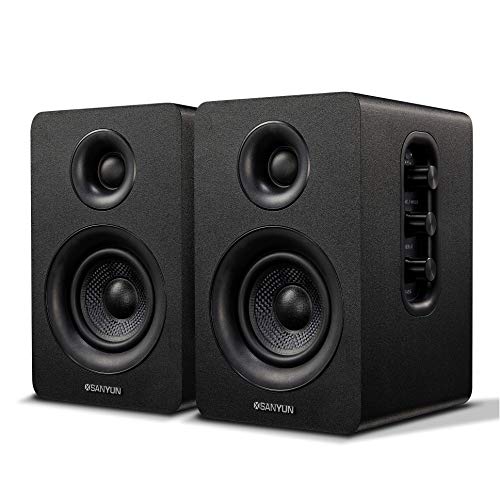
The Sanyun SW208 is a compact pair of active bookshelf speakers with 3-inch carbon-fiber driver units. Each speaker is rated at 30 watts, giving this two-speaker setup enough output for a desk, bedroom, or small office. Bluetooth 5.0 handles wireless playback, while a USB connection sends digital audio to the built-in 24-bit DAC. That wired option can help avoid some signal loss compared with basic analog connections.
Its strongest feature is the amount of control packed into a small system. The main speaker has separate knobs for volume, treble, and bass, so you can adjust the sound for music, videos, or games. The design aims for a warm midrange, firm low end, and clear treble, though a 3-inch driver cannot produce the same bass depth as a larger speaker or subwoofer. A built-in noise-filtering system reduces unwanted sound during standby, and the speakers use an energy-saving design. At $55.99, they offer useful connectivity without needing a separate amplifier.
Pros
- Built-in 24-bit DAC provides a direct USB audio path from compatible devices.
- Bluetooth 5.0 allows wireless playback without an external receiver.
- Separate bass and treble knobs make quick sound adjustments easy.
Cons
- Three-inch drivers have limited deep-bass output, especially without a subwoofer.
- The controls sit on the main speaker, so changing settings requires reaching across the desk.
3. Saiyin Powered Bluetooth Bookshelf Speakers

Best for: Small rooms, desks, and budget setups
The Saiyin Powered Bluetooth Bookshelf Speakers are a $69.99 pair with one active speaker and one passive speaker. The active unit measures 5.3 inches wide, 6.3 inches deep, and 8.6 inches high, so they fit on many desks or compact shelves. Bluetooth 5.3 handles wireless playback from phones, tablets, Macs, and PCs. A 3.75-inch woofer handles lower frequencies, while the 0.5-inch silk-dome horn tweeter covers higher notes. No separate amplifier or receiver is needed.
Wired connections give this pair more flexibility than basic computer speakers. Inputs include optical, coaxial, 3.5mm, and dual RCA, with the included speaker cable linking the two cabinets. A remote changes volume, mutes the system, and switches between Bluetooth, line-in, optical, and coaxial modes. Top-panel buttons provide backup control, and the remote can be replaced for the product’s lifetime. Turntable setup requires careful matching. A record player with line output can connect directly, but a model with only phono output needs a preamplifier. Bluetooth also works only when the turntable can transmit audio.
Pros
- Bluetooth 5.3 supports wireless playback from several common devices.
- Optical, coaxial, RCA, and 3.5mm inputs suit TVs, computers, and audio equipment.
- The included remote controls volume, muting, and input selection from across a room.
Cons
- The speakers require PCM, stereo, or non-surround output, so some sources may need audio-setting changes.
- Bluetooth turntable use requires a transmitter, while phono-only turntables need a separate preamplifier.
2. Edifier R1280T Powered Bookshelf Speakers
Best for: Desktop listeners wanting simple wired audio
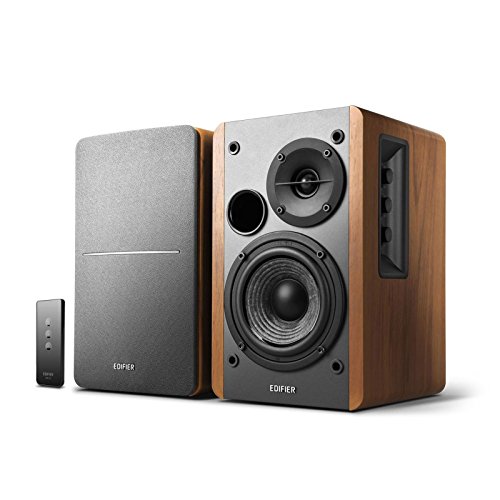
The Edifier R1280T is a pair of powered 2.0 bookshelf speakers for desks, small rooms, and near-field listening. One speaker houses the amplifier, so the setup does not need a separate receiver. Each cabinet uses a 4-inch full-range driver and a 13mm silk-dome tweeter. At $129.99, this is a straightforward option for computer audio, turntables with a built-in preamp, or other analog sources.
Its most useful feature is the dual AUX setup. You can connect two devices at once through 3.5mm or dual RCA inputs, then switch between them without moving cables. A compact remote handles volume from across the room, while knobs on the powered speaker adjust bass and treble. The MDF cabinets have a wood-effect vinyl finish, giving them a traditional look instead of a plain plastic shell. Still, these are wired speakers, and the listed connections do not include Bluetooth or a digital input. The 4-inch drivers also suit close listening better than filling a large room with deep bass.
Pros
- Two AUX inputs support simultaneous connections from separate devices.
- The 13mm tweeter and 4-inch driver provide a two-way speaker design.
- Remote volume control and side-mounted bass and treble knobs simplify adjustments.
Cons
- No Bluetooth, optical, or USB input is listed, limiting connection choices.
- The 2.0 design has less low-end reach than speakers paired with a subwoofer.
1. Polk Audio T15 Bookshelf Speakers

Best for: Entry-level surround sound systems
The Polk Audio T15 is a pair of passive bookshelf speakers for home theater and music. Each speaker uses a 0.75-inch tweeter and a 5.25-inch Dynamic Balance driver. Polk rates the pair for up to 100 watts, while the larger driver handles the main audio range and bass. These speakers can work as front left and right channels, or as rear surrounds in a compatible setup.
Their biggest strength is flexibility for a $125 pair. The cabinets are wall-mountable, so they can sit on shelves or move out of the way on a wall. A basic setup only requires speaker wire and an AV receiver. The T15 also fits into a broader Polk system. Buyers can later add T50 tower speakers, a T30 center channel, and a subwoofer for a 5.1 arrangement. That makes this pair a practical starting point for a home theater, especially when clear dialogue and balanced sound matter more than maximum bass output.
Pros
- Includes a 0.75-inch tweeter and 5.25-inch driver for balanced home audio.
- Wall-mountable design supports front, left-right, or rear surround placement.
- Works with an AV receiver and can grow into a Polk 5.1 system.
Cons
- Passive speakers need an AV receiver or amplifier, plus speaker wire, to operate.
- The pair does not include a center channel or subwoofer, so deep bass and dialogue focus may require additional speakers.
Buying Guide
Choose between powered and passive speakers first. Powered pairs include built-in amplification, while passive models need a separate receiver or amplifier, which can raise the total cost.
- Amplification: For powered speakers, look for 50 to 100 watts per channel for a small or medium room. Passive speakers should list 4- or 8-ohm impedance and work with an amplifier rated around 20 to 100 watts per channel.
- Cabinet size and placement: Many bookshelf models measure 6 to 10 inches tall. Allow 6 to 12 inches behind rear-ported cabinets, and use stands if the shelf leaves the tweeters below ear level.
- Bass response: A stated low end near 50 to 60Hz suits music without a subwoofer. Choose a speaker with a subwoofer output if you want bass below 40Hz for movies or electronic music.
- Connections: Powered pairs should include at least RCA or 3.5mm input. Optical input helps with TVs, while Bluetooth adds phone streaming. Passive pairs need quality speaker-wire terminals.
- Price and contents: Confirm whether the price covers two speakers, not one. Around $150 to $300 usually leaves room for a useful cabinet, solid drivers, and a one- or two-year warranty.
If you cannot have everything, prioritize system compatibility and amplifier requirements first.
Frequently Asked Questions
How much should I spend on bookshelf speakers under $300?
You should spend about $150 to $300 for a strong pair of bookshelf speakers, depending on room size and features. Models near $200 often include better cabinets or bass drivers, while lower-priced options may need a subwoofer or external amplifier. A 4-inch woofer suits small rooms, while 5.25-inch drivers usually produce fuller bass.
What features matter most when choosing affordable bookshelf speakers?
The most useful features are sensitivity, impedance, woofer size, and connection type. Look for sensitivity around 85 dB or higher, 6- or 8-ohm impedance, and a 4- to 6.5-inch woofer. Passive models also need an amplifier, while powered versions accept sources such as a TV, phone, or turntable.
Can bookshelf speakers under $300 fill a large room?
Bookshelf speakers under $300 can fill a large room, but they need enough amplifier power and careful placement. Choose models with 5.25- or 6.5-inch woofers, place them on stands, and keep them 8 to 12 inches from the wall. For movie sound or deep bass, add a powered subwoofer.
Are powered or passive bookshelf speakers better under $300?
Powered bookshelf speakers are better for simple setups, while passive pairs offer more upgrade flexibility. A powered pair can connect directly to a TV or computer, but its built-in amplifier cannot be replaced. Passive speakers need a separate amp, yet you can change that amp later. Budget about $100 to $200 for a basic one.
Conclusion
Polk Audio T15 Bookshelf Speakers remain the top recommendation for listeners who already own a stereo receiver or amplifier and want affordable sound for music, TV, gaming, or a compact living room. If your priority is a simpler setup without separate equipment, choose a powered pair such as the Edifier R1280T, which includes built-in amplification and direct connection options for sources like a phone, computer, or television. Before buying, double-check each model’s cabinet size, passive or powered design, connection compatibility, amplifier requirements, whether the listed quantity means one speaker or a pair, and the current price, since discounts and package contents can change.
